

Blog
Paper Pods vs Capsules, What’s the Real Difference?

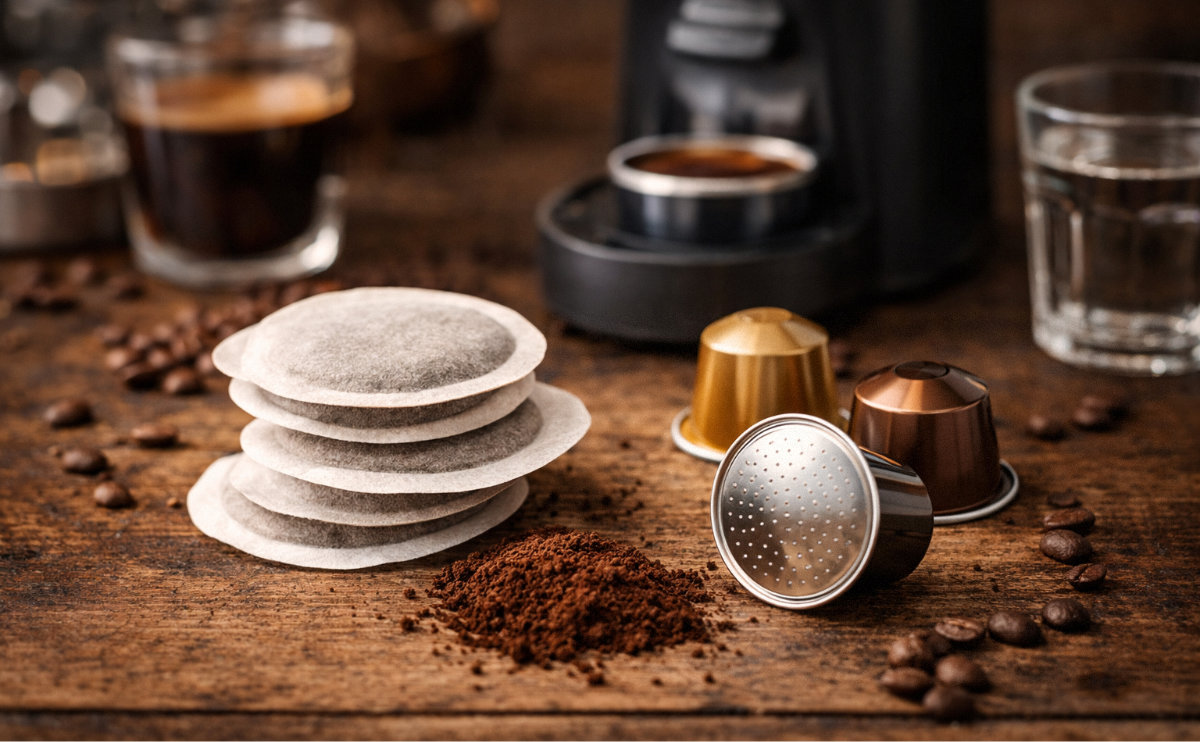
At first glance, paper pods and capsules can seem like two versions of the same idea. Both are portioned. Both are designed to make coffee easier. Both appeal to people who want speed, simplicity, and consistency in daily use.
But once you look at how they actually work, they are very different systems.
They are built around different brewing paths, different machine mechanics, different material choices, and often a very different idea of what the final cup should feel like. That matters, because in coffee, the system is never neutral. The way the machine introduces water to the coffee, the way the coffee is held during extraction, and the way pressure or movement is used during brewing all influence what ends up in the cup. Espresso itself is defined in scientific literature as hot water passing under elevated pressure through a packed bed of finely ground coffee over a short time, and that is an important starting point for understanding why different single-serve systems can taste so different.
At Puca Coffee, this matters because we do not see coffee as just a delivery system for caffeine. We see it as a daily ritual, a sensory experience, and for many people, especially those familiar with traditional Italian espresso, something with a very clear benchmark. The benchmark is not simply whether the coffee is strong enough or whether there is a layer on top. The benchmark is body, texture, aroma, balance, and whether the cup feels like a real espresso rather than merely a convenient coffee product.
That is why the discussion around paper pods versus capsules is not just about convenience. It is about what kind of coffee culture you want to preserve.
An open format versus a closed system
The first major difference is structural.
Paper pods in the E.S.E. format belong to an open standard. The standard is built around a pre-packaged serving of ground coffee, pressed and enclosed between thin layers of filter paper, with the pod dimensions and format tightly defined so that compatible pods and compatible machines can work together across different producers. The E.S.E. consortium describes the format as an open system for espresso coffee prepared with paper pods, and it defines the standard pod at roughly 44 mm, with a single measured coffee dose sealed inside the paper structure.
That is very different from the logic of most capsule systems.
In a capsule system, the coffee is enclosed inside a rigid container that is normally proprietary to a particular platform. That container is not only holding the coffee. It is usually part of the brewing architecture. The machine is designed around that capsule’s geometry, the way it is pierced, the way water enters it, and the way the brewed liquid leaves it. In other words, the brew is shaped not just by the coffee but by the engineered container itself. Pressure-led capsule platforms explicitly market the high-pressure extraction system as a key part of the experience, while spin-based platforms market the rotational brewing mechanics as a defining feature of their extraction style.
This is one of the biggest technical differences in the whole comparison.
With paper pods, the format is built around the coffee portion and the compatibility of the machine with that portion. With capsules, the format is usually built around a closed machine-and-container ecosystem. That does not automatically make capsules inferior. But it does mean the result is often more system-led and more container-led, while paper pods remain more directly coffee-led.
Paper pods are every bit as convenient in daily use
One of the biggest misunderstandings in this whole conversation is the assumption that capsules are convenient, while paper pods are somehow less practical or less modern.
That is not true.
Paper pods are already portioned, sealed, tidy, quick to insert, and easy to remove after brewing. In normal day-to-day use, they are also a single-serve system. You are not weighing coffee every time. You are not adjusting grind every time. You are not tamping from scratch every time. The E.S.E. consortium describes the system as being designed to simplify espresso preparation into a few easy gestures, with the advantages of convenient single servings, ease of use, and reduced coffee residue. That means convenience is not something capsules invented and paper pods failed to catch up with. Convenience is also built into the paper pod system itself.
The same applies to consistency.
A portioned system reduces variables. Because each pod is pre-measured, enclosed, and standardised, there is less room for user error around dosing and preparation. That does not mean every machine will produce the same result regardless of quality. Machine design still matters. Coffee quality still matters. Roast style still matters. But the underlying format is clearly built for repeatability, and the E.S.E. standard itself is based on controlling variables such as portion size and serving format so that the machine can produce a stable result more reliably.
So the honest comparison is not “convenient capsules versus inconvenient pods.”
The honest comparison is that both are convenient single-serve systems, but they arrive at that convenience in different ways. Capsules do it through a closed engineered shell. Paper pods do it through a simpler paper-based portion that stays closer to classic espresso logic.
If you want to explore machines built around that more traditional approach, you can browse our coffee machines collection.
How paper pod machines actually brew the coffee
To understand why the cup can feel different, it helps to understand the brew path itself.
A paper pod machine, especially in E.S.E.-compatible espresso-style systems, works much closer to the logic of classic espresso extraction. The pod is essentially a prepared portion of ground coffee enclosed in paper. The machine is designed so that water passes through that coffee portion in a controlled extraction chamber shaped to suit the serving format. The E.S.E. standard describes a brew group with a geometry tailored to the serving shape and defines parameters such as coffee quantity, grind, compression, temperature, and water pressure so that the machine can consistently produce espresso from the pod.
That point is more important than it may seem.
In practical terms, the pod behaves much more like a prepared coffee bed than like a miniature rigid brewing capsule. The coffee is still presented as coffee, enclosed in a very thin filter-paper structure, and the brewing logic still resembles the idea of espresso as water being pushed through a compact serving of ground coffee. That is why many people experience paper pod coffee as feeling closer to a bar-style espresso. The machine is still extracting through coffee in a way that resembles espresso preparation, rather than relying on a more engineered internal chamber built into the serving itself.
This is also where a lot of Italian espresso drinkers make an immediate sensory connection.
Even before getting into chemistry or machine design, they notice that the cup feels closer to what they expect from espresso. It feels denser, fuller, and more direct. The coffee can feel less mediated by the packaging system and more like an actual extraction of coffee.
If you want to see how that philosophy carries through into the full Puca range, visit the Puca Coffee shop.
How capsule machines brew the coffee
Capsule systems work differently, and one of the most important things to say clearly is that capsules are not all one single technology.
Some capsule systems rely on high-pressure extraction. One major capsule platform describes its original system as using a 19-bar high-pressure extraction process to deliver the coffee. In these systems, the machine injects hot water into the rigid capsule under pressure, and the extraction happens through the structure of that capsule and the way the machine is designed to pierce and flush it.
Other capsule systems work very differently. Spin-based systems use rotational brewing mechanics, with official product pages describing capsules spinning up to 4,000 rpm during extraction. In those systems, the machine is not simply pushing water through a coffee puck in the traditional espresso sense. It is using a different extraction design, one where the spinning of the capsule plays a direct role in how the beverage and top layer are formed.
That is why it is not technically accurate to say all capsules work in exactly the same way.
The more accurate point is that capsule brewing is a family of closed-system technologies. Some are pressure-led. Some are spin-led. Some emphasise a more espresso-like cup. Others are built for a broader multi-size beverage concept. But what they share is that the serving container itself is part of the brew mechanism.
That is the real divide.
With paper pods, the coffee is held in paper and brewed in an espresso-oriented path. With capsules, the coffee is enclosed in a proprietary chamber that actively shapes the extraction.
Why crema matters so much
For people who grew up with traditional Italian espresso, one of the biggest differences is not just taste in the abstract. It is mouthfeel and crema.
Scientific literature describes fresh espresso as having a thick layer of dense reddish-brown foam made up of small gas bubbles, commonly referred to as crema. That crema is not merely cosmetic. It is associated with gases released from the coffee, volatile aromatic compounds, and the emulsified liquid structure of espresso itself. Other scientific work describes espresso as an aqueous emulsion of coffee oils covered by a foam layer, and the appearance of that crema has long been treated as an important sign of extraction quality.
That matters because not every top layer behaves the same way in the mouth.
A drink can have a visually impressive head while still feeling light, airy, or less integrated with the liquid beneath it. This is where many espresso drinkers make a distinction between crema and simple foam. In practical tasting language, crema feels dense, compact, and part of the coffee. Foam feels more aerated, lighter, and sometimes less connected to the body of the drink. That distinction is not anti-technology. It is a real sensory distinction, and one that many people immediately recognise even if they do not describe it in scientific terms.
This is one reason paper pod espresso is often experienced as more authentic by drinkers whose benchmark is the Italian bar. The brewing path stays closer to espresso logic, and the result can feel more naturally integrated in the cup. It is not simply about having a layer on top. It is about what that layer is doing, how it sits on the coffee, and how the whole drink feels when it reaches the palate.
Pressure numbers alone do not explain quality
Coffee marketing often leans very heavily on pressure numbers.
You will often see capsule systems highlight 19-bar extraction as a sign of superiority. But pressure by itself does not explain cup quality. Espresso science defines espresso much more broadly than a single pressure number. What matters is the whole extraction system, including the coffee bed, contact time, flow behaviour, grind, temperature, and the way the brewing path is designed. A high pump rating does not automatically mean a more authentic or more satisfying espresso if the brewing architecture is fundamentally doing something different from classic espresso extraction.
That is why it would be a mistake to reduce the conversation to pump pressure alone.
The better question is whether the machine extracts in a way that preserves the body, mouthfeel, and integrated crema associated with espresso. For many people, especially those used to a traditional Italian cup, paper pod systems answer that question very well because they remain closer to the logic of water passing through a compact coffee portion in an espresso-style path.
Capsules do have strengths, but they solve a different problem
To be fair and technically honest, capsule systems do have real strengths.
The strongest of those strengths is control. A tightly engineered closed system is very good at minimising variables and producing a repeatable outcome. That is one reason capsule coffee became so popular in homes and offices. The machine and serving format are designed together, and that makes it easier to deliver predictable results without requiring much skill from the user. Official capsule-system marketing strongly emphasises this kind of controlled extraction and consistency of result.
But repeatability is not the same as authenticity of cup style.
A system can be extremely repeatable and still produce a drink that feels less like traditional espresso. That is really the heart of the comparison. Capsules are excellent at engineered convenience. Paper pods are excellent at giving you convenience while staying closer to the sensory logic of espresso. Those are not identical goals, even when both systems are sold as single-serve coffee solutions.
Freshness is not a capsule monopoly
Another point worth correcting is the idea that only capsules preserve freshness.
Capsules do have a strong barrier story. That is a real strength of rigid sealed packaging. But paper pods are not the same as loose exposed coffee. The E.S.E. format is itself described as a pre-packaged and hermetically sealed single serving. In other words, the system is also designed around freshness and dose protection. The choice is not between fresh capsules and stale pods. The choice is between two different ways of portioning and protecting a single serving of coffee.
That distinction matters because it keeps the comparison honest.
If a pod is properly packed and stored, it can still deliver a very satisfying fresh cup while keeping the structure of the format much simpler. Capsules may maximise barrier engineering, but properly packaged E.S.E. pods also protect freshness while using a filter-paper serving rather than a rigid plastic or aluminium coffee capsule.
If you want to guide readers toward that format, this is a good place to link to your paper pod range.
Materials, heat, and the preference for simplicity
There is also the question of what the hot water is actually passing through.
Many coffee drinkers instinctively prefer the idea of water passing through paper and coffee rather than through a rigid capsule made from plastic, aluminium, or mixed materials. That preference is understandable. It reflects a desire for simplicity and a sense that the brewing path should be as direct as possible. From a coffee-culture point of view, that preference makes perfect sense, especially for people who associate good espresso with a simple relationship between coffee, water, pressure, and extraction.
At the same time, it is important not to turn that into exaggerated fear-based messaging.
The technical point does not need to be “capsules are dangerous” in order to be meaningful. The more precise difference is in the serving format itself. E.S.E. pods hold the coffee in filter paper rather than inside a rigid plastic or aluminium capsule. Puca Coffee’s E.S.E. pods use DIN-certified compostable filter paper, compliant with EN 13432.
That is a philosophical argument, but it is also a sensory one. Many people feel that directness in the cup.
Waste, openness, and coffee culture
Paper pods also make a strong case beyond the cup itself.
Because the E.S.E. system is an open standard, it is not built around trapping the drinker inside a single closed ecosystem. That matters for choice, but it also matters for how the format is perceived. The focus stays more on the coffee and less on the machine brand’s proprietary universe. The E.S.E. format uses a standardised paper pod rather than a rigid plastic or aluminium coffee capsule, and Puca Coffee’s E.S.E. pods use DIN-certified compostable filter paper, compliant with EN 13432.
That combination of openness and simplicity is one of the format’s biggest strengths.
It means paper pods do not only speak to convenience. They also speak to clarity, an open standard, and a more direct relationship between the drinker and the coffee. For many people, especially those who care about coffee as culture and not only as a quick functional drink, that makes a real difference.
If you want to bring readers back into the broader brand story here, this is the perfect place to link to your About Us page.
The real conclusion
If the goal is highly engineered convenience, closed-system control, and very tightly managed extraction from a proprietary serving format, capsules are extremely strong.
If the goal is convenience without moving too far away from the logic and feel of real espresso, paper pods make a very compelling case.
They are portioned, sealed, clean, practical, and genuinely convenient. They support consistency. They preserve freshness. They work through a brew path that stays much closer to espresso logic. They avoid much of the rigidity and lock-in of closed capsule ecosystems. And for many people, especially those whose benchmark is the coffee bar rather than the gadget, they simply produce a cup that feels closer to what espresso should be.
That is why, for us, paper pods are not just another single-serve option.
They are one of the smartest ways to keep everyday simplicity while staying much closer to the real spirit of Italian coffee.
